The history of the Catacombs of Paris dates back to the late 18th century. Credit: Paris Musées

Four modern cities with secret tunnels

From war bunkers and espionage tunnels to monumental ossuaries, major metropolises have fascinating underground worlds. We explore the tunnels hidden beneath Berlin, London, Paris, and New York.

ISABEL RUBIO ARROYO | Tungsteno


Many modern cities conceal beneath their streets a vast network of secret tunnels that serve various purposes, ranging from former shelters and military command centres to historic ossuaries. Cities like Berlin, London, Paris, and New York reveal that urban life and history extend beyond the surface. Their depths hold a captivating heritage of wartime bunkers, espionage routes, and abandoned infrastructure.

Berlin

Berlin's tunnels have historically served as strategic refuges and military command centres, preserving stories from the Second World War through the Cold War. Several associations are dedicated to exploring and documenting these underground spaces, offering guided access to iconic air-raid shelters and bunkers. Their aim is to show how the city prepared for conflict and how these structures protected its inhabitants during times of crisis.

Beyond shelters, escape tunnels tell stories of ingenuity and resistance. More than 70 tunnels were built beneath the Berlin Wall, enabling some 300 people to flee from East to West. The city’s subterranean past also hides other disused infrastructure, such as abandoned railway tunnels and even former brewery warehouses.


During the Cold War, some tunnels were used as escape routes. Credit: DW Euromaxx


London


The Kingsway Exchange tunnels complex, which stretches across 8,000 square metres beneath High Holborn, was built during the Second World War to protect Londoners during the Blitz. Although it was never used for that purpose, the site hosted the Special Operations Executive (SOE), Winston Churchill's wartime espionage organisation. James Bond author Ian Fleming worked regularly with the SOE in this labyrinth of tunnels, which may have inspired Q Branch in his famous novels.

The tunnels remained strategically important after the war. During the Cold War, they functioned as a strategic communications hub. Following the Cuban missile crisis in 1962, the complex served as a relay point for the famous “red telephone” hotline between the Pentagon and the Kremlin. A government bunker was also built for use in the event of a nuclear attack. Today, there are plans to open the site to the public as a tourist attraction, featuring a military intelligence museum, an exhibition on espionage, and a bar marketed as “the deepest bar in the world in a city.”


The passages that protected London during the Second World War.


Paris


Much of the Parisian subsoil consists of nearly 200 miles (about 320 kilometres) of limestone quarries, originally excavated to build the city. Part of this network forms the Paris Catacombs, one of the largest ossuaries in the world. They contain the remains of some six million Parisians and have been dubbed "the empire of death." These abandoned quarries are sometimes visited illegally by "urban explorers," who have been known to organise secret underground nightclubs and cinemas.

Paris also boasts a complex sewer system spanning 1,662 miles (around 2,675 kilometres), modernised in the 19th century and historically used as escape routes for criminals. The metro network also includes four “ghost” stations closed since the Second World War. Other underground points of interest include a secret military bunker near the Eiffel Tower and the basement of the Opéra Garnier, which houses a real underground lake.


The catacombs of Paris lie 20 metres underground, with 243 steps and 2,000 metres of tunnels. Credit: Paris Musées


New York


In 2024, an illegal tunnel was discovered in Brooklyn, New York, beneath the Chabad-Lubavitch headquarters in Crown Heights, a busy Jewish site that welcomes thousands of visitors a year. The 60-foot (18-metre) tunnel was dug clandestinely and without structural reinforcements, causing destabilisation under the synagogue sanctuary. Due to safety concerns, New York City issued an emergency order to stabilise the building.


Illegal tunnel discovered beneath an historic synagogue in Brooklyn, New York. Credit: Eyewitness News ABC7NY


The evidence suggests the tunnel was constructed by a group of students known as the Tzfatim, who sought to expand the synagogue in accordance with the vision of their deceased leader, Rabbi Menachem Mendel Schneerson. When police arrived to inspect the tunnel, clashes broke out with members of the community. The altercation resulted in nine arrests on charges including criminal damage, reckless endangerment, and obstruction of government administration.


Tungsten is a journalistic laboratory that explores the essence of innovation.

Margarete Schütte-Lihotzky, designer of the iconic Frankfurt Kitchen. Credit: Wikimedia Commons.

The architect behind the modern kitchen

Margarete “Grete” Schütte-Lihotzky was far more than the creator of the Frankfurt Kitchen. A pioneering architect, anti-fascist activist, and advocate for social housing and early childhood education, her legacy transformed not only the home but also the society in which she lived.

ISABEL RUBIO ARROYO | Tungsteno


Margarete Schütte-Lihotzky didn’t just design the modern kitchen—she envisioned a more efficient home and a future where women would have more time to themselves. With her iconic 1927 Frankfurt Kitchen, she sought to optimise every movement within the home. Her design introduced features we now take for granted, such as continuous countertops, well-organised drawers, and a meticulously planned workflow. Yet what began as a symbol of female emancipation, intended to free women from endless domestic labour, was eventually criticised as a space that isolated and confined them instead.


"You can kill a person with an apartment."


Schütte-Lihotzky was one of the first women in Austria to graduate in architecture. Although her family held progressive views for the time, they initially disapproved of her career choice, believing that no one would hire a woman to design a house in 1916. Her interest in social housing arose after observing the harsh living conditions of Vienna’s working class. She witnessed nine people sharing a single room and tenants subletting beds for a few hours a day. "You can kill a person with an apartment just as well as with an axe," wrote the German artist Heinrich Zille, a quote that the architect would later include in her own memoirs.

Following the First World War, Germany faced a severe housing shortage, leading to large-scale social housing projects for working-class families. At that time, workers' homes typically had only two main rooms: one served as the space for cooking, bathing, eating and sleeping, and the other functioned as a living area. This layout resulted in poor hygiene and a lack of functional differentiation between the work area and the relaxation area. Schütte-Lihotzky designed the Frankfurt Kitchen as part of an affordable public housing programme. Her goal was to streamline domestic work and reduce the time women spent on kitchen tasks.


The iconic Frankfurt Kitchen. Credit: The Design Museum


The prototype of the modern kitchen


The Frankfurt Kitchen came to be recognised as the prototype of the modern fitted kitchen and as one of the greatest revolutions in 20th-century social housing design. It introduced features that are now standard, such as continuous worktops, tiled splashbacks, built-in drawers, and storage-optimised cabinets. The design featured a sliding door to separate the kitchen from the living room. To maximise efficiency, Schütte-Lihotzky based her layout on studies and interviews with housewives, aiming to minimise unnecessary movement within the space. The kitchen was designed so efficiently that a woman could move from the sink to the stove without taking a single step.

Around 10,000 units of the Frankfurt Kitchen were built for the social housing projects designed by architect Ernst May. Today, original examples can be seen in museums around the world, including the MoMA in New York. For Schütte-Lihotzky, the real goal of this kitchen design was to promote social reform and contribute to the emancipation of women by reducing the burden of unpaid domestic labour. Her intention was to give women more time for education, work, and leisure.


The Frankfurt Kitchen at the MoMA museum. Credit: The Museum of Modern Art


However, over time, that vision came under criticism. Beginning in the 1970s, some feminist movements argued that that, far from liberating women, the kitchen had in fact become a space of confinement, designed exclusively for women's work. Its compact size and tight proportions, intended to reduce costs and optimise movement, meant that it was impossible for more than one person to use the space comfortably. This inadvertently reinforced the notion of the kitchen as a private and solitary realm reserved solely for women.

An overshadowed legacy

Schütte-Lihotzky took her social commitment beyond architecture, becoming actively involved in politics and the anti-fascist resistance. She joined the Austrian Communist Party in 1938 and was arrested by the Gestapo in 1941. Her ideals brought her professional hardships in Cold War-era Austria, and in 1988 she rejected the Austrian Medal for Science and Art in protest against what she saw as the sitting president's complicity in Nazi war crimes.

Her other projects—often overshadowed by the Frankfurt Kitchen—included the design of flats for single working women and groundbreaking innovation in educational spacesShe designed kindergartens using a modular construction system that included cots, changing tables, chairs, desks, and other objects that made the space more flexible. Schütte-Lihotzky died in 2000 at the age of 102. Although the Frankfurt Kitchen remained her most famous work, she ultimately regretted that it had come to define her legacy. At the age of 101, she exclaimed, "If I had known that everyone would keep talking about nothing else, I would never have built that damned kitchen!"


Tungsten is a journalistic laboratory that explores the essence of innovation.

Artificial Intelligence for Predicting Road Condition

The Apromac project allows us to estimate key road surface indicators. By integrating these indicators with external factors such as weather conditions, we obtain an accurate view of the actual condition of the roads, both in the short and long term.

At Sacyr we build and maintain thousands of kilometers of road infrastructure around the world. Knowing its condition and anticipating its evolution is vital to guarantee its functionality and safety.

The Report on Investment Needs in Conservation 2025 of the Spanish Road Association estimates that the required amount to fine-tune the national road network is €13.5 Bn. This all-time record figure represents a 43% increase compared to 2022.

Recognizing this need, Sacyr is developing Apromac, a tool that predicts the state of road surfaces. To do this, we apply technologies such as Big Data and artificial intelligence to predict the evolution of the main parameters of the condition of road infrastructure.

"Not only do we use data from the infrastructure itself, but in the analysis we also incorporate standardized information from other Sacyr Concesiones roads and studies on the influence of factors like temperature and rainfall," explains Sergio Campos, project manager.

This tool allows us to improve planning through predictive models for deterioration indicators such as macrotexture, ruts (depressions in the wheel path), and the transverse friction coefficient (TFC), an indicator of skid resistance. In addition, various types of models have been trained and validated to identify which one offers greater accuracy in predictions.

The first project milestone was reached at the end of 2023 and the second is planned for the end of 2025.


Apromac was developed using data from several roads managed by Sacyr: Ruta del Desierto and Limarí (Chile); Turia, Pamasa, Eresma and Aunor (Spain); Pamplona-Cúcuta (Colombia); and Pirámides-Tulancingo-Pachuca (Mexico).

This project has a €500,000 budget and will run until December 31, 2025. Once completed, Sacyr Concesiones will have an advanced tool for long-term prediction of road behavior.

Apromac is co-financed by the European Union, with funding from European Funds, the Spanish Ministry of Finance, and CDTI through the Ministry of Science, Innovation and Universities.

In the future, this tool will have two major impacts: it will allow for better-informed reinvestment strategies in road tenders, considering factors such as project year and financial impact; and it will facilitate monitoring in the operation phase, enabling more efficient planning and execution of necessary road maintenance based on predicted degradation.

0 Folders
2 Documents
1 Folder
0 Documents
  • CSR

Successful implementation of the Sustainable Suppliers program

Sacyr has participated in the II (2024) and III (2025) editions of the Sustainable Suppliers program to collaborate in its transition towards more sustainable business models.

The Sustainable Supplier Training Program of the UN Global Compact Spain, ICEX and Fundación ICO has facilitated the training of more than 2,300 SME suppliers from more than 72 countries.

This program provides them with knowledge and resources on corporate sustainability, as well as help in complying with the requirements of the national, European and international regulatory frameworks on the subject.

In the latest edition, this year, 40% of our suppliers have completed the training, joining the other 48 large companies that have promoted sustainability training in their respective supply chains.

This initiative was launched in 2023 with the aim of training SME suppliers of large companies in the key principles of the UN Global Compact and the Sustainable Development Goals (SDGs). Since its inception, the program has managed to train more than 5,000 supplier companies in the integration of sustainable practices into their business models.

This edition has stood out for the high level of satisfaction among the participating SMEs, as 91% of them consider that the training has been useful for their company, which underlines the confidence and effectiveness of the initiative.

For Sacyr, the impact of responsible management in its supply chain is very relevant, as it is the main barrier that large companies encounter when promoting sustainability.

2nd Edition of Business & Human Rights

The Sacyr Foundation also participated in the 2nd Edition of the Business & Human Rights Accelerator, along with 56 other companies in Spain.

This innovative six-month program is designed to train companies from all sectors and regions in the implementation of effective human rights due diligence processes.

Through practical tools and expertise, companies can ensure that their operations respect and promote human rights, contributing to the development of a more ethical and sustainable business environment.

The Business and Human Rights Accelerator program is part of the pioneering international outreach programs that the UN Global Compact offers companies to achieve real and effective action on key aspects of the 2030 Agenda and the Ten Principles of the Global Compact.

Featured projects
Charged to 2024 profits
Payment date New shares trading date Last trading date Gross amount Net amount* Concept
01/07/2025 - 26/06/2025 0.0450€ 0.0364€ Cash dividend
29/01/2026 pendiente 12/01/2026 0,0450€ (1) 0,0364€ Scrip Dividend 1X80

*Applying 19% withholding

(1) Amount paid in cash to shareholders who did not opt to subscribe for new shares free of charge in the ratio of 1 share for every 80 rights.

  • Corporate

We imagine, design, and create progress

Our 2025 corporate video highlights the solid values that make us leaders in infrastructure development worldwide.

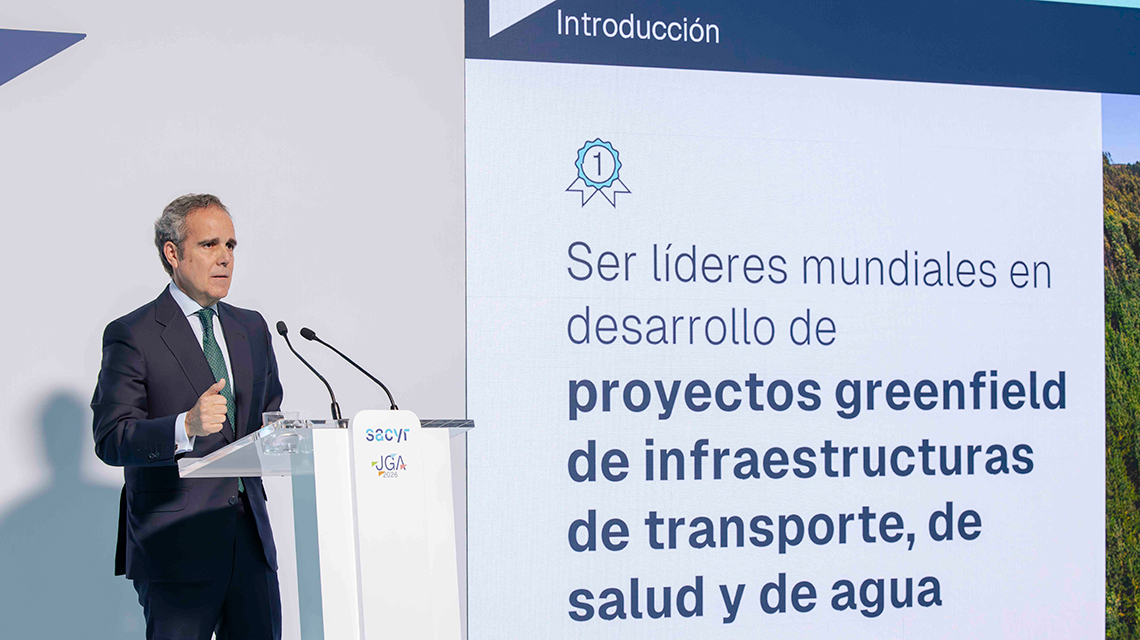
Our vision for 2033 is to be the largest concessionaire of greenfield infrastructure, social, and water projects in the world. To achieve this, we drive long-term sustainable growth, continuously generating value.

We have an expert and committed team in each project to generate a positive impact wherever we operate. We are a leading concessionaire in the development of transport, social, and integrated water cycle infrastructures with a solid, efficient, and stable business model.

We make possible the progress we deserve: imagining, designing, creating, and caring for infrastructure that makes us advance and prosper.

We tell you all about it in our corporate video:


Featured projects
  • Results

Q1 2025 Results Presentation Announcement

The company announces call notice of the Q1 2025 results presentation.

The results presentation will be held on Wednesday, April 30th 2025, at 12:00h (CEST).

You can follow the audio-webcast stream in real time on this link.

Featured projects

Analyst coverage recommendations

  • BUY
  • HOLD
  • SELL

15 Analysts

Entity Analyst
Alantra Fernando Lafuente / Álvaro Lenze
Alphavalue Egor Sonin
Banco Santander Mariano Miguel
Bank of America Julius Nickelsen
Barclays Tom Zhang
BPI Caixabank Filipe Martins Leite
Bestinver Álvaro Navarro Ruiz
GvC Gaesco Rafael Fernández de Heredia
Intermoney Guillermo Barrio
JB Capital Miguel González
Kepler Cheuvreux Luis Prieto
Sabadell Luis Arredondo Sánchez-Cendal
Bernstein Víctor Acítores
Renta 4 Ángel Pérez Llamazares
BNPP Exane Gonzalo De Cueto Moreno

This website uses its own and third-party cookies to improve the user experience and analyze their behavior in order to improve the service offered.
You can consult additional information about the cookies installed on our Cookies policy.

Cookie Settings

Cookie declaration

TECHNIQUES

These cookies are exempt from compliance with article 22.2 of the LSSI in accordance with the recommendations indicated by the European authority on privacy and cookies. In accordance with the above and although configuration, acceptance or denial is not possible, the editor of this website offers information about them in an exercise of transparency with the user.

  • Name: LFR_Session_STATE_*, Provider: Liferay, Purpose: Manages the session as a registered user , Expiration: Session, Type: HTTP

  • Name: GUEST_LANGUAGE_ID, Provider: Liferay, Purpose: Determines the language with which you access , to show the same in the next session, Expiration: 1 year, Type: HTTP

  • Name: ANONYMOUS_USER_ID, Provider: Liferay, Purpose: Manages the session as an unregistered user , Expiration: 1 year, Type: HTTP

  • Name: COOKIE_SUPPORT, Provider: Liferay, Purpose: Identifies that the use of cookies for the operation of the portal, Expiration: 1 year, Type: HTTP

  • Name: JSessionID, Provider: Liferay, Purpose: Manages login and indicates who is using the site, Expiry: Session, Type: HTTP

  • Name: SACYRGDPR, Supplier: Sacyr, Purpose: Used to manage the cookie policy , Expiration: Session, Type: HTTP