SacyrNewsUn perro robótico para inspeccionar el interior de las presas
Share:
Un perro robótico para inspeccionar el interior de las presas
Una máquina recorre las galerías de la infraestructura hidráulica para tomar imágenes que facilitan las tareas de vigilancia y conservación.
08/06/2026
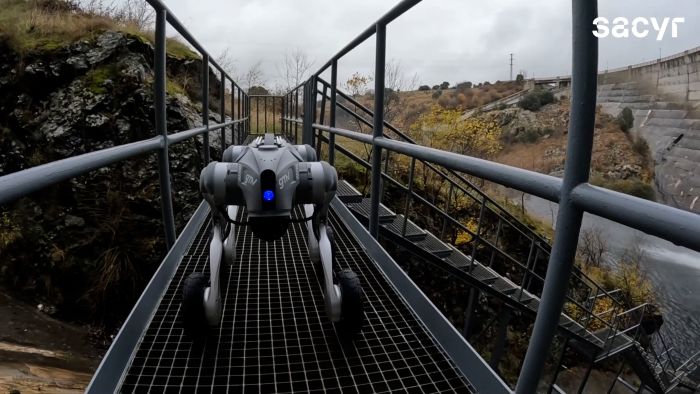
Sacyr Conservación ha empezado a usar cuadrúpedo robotizado que inspecciona las galerías kilométricas que existen en el interior de las presas.
Las infraestructuras hidráulicas tienen una difícil conectividad con el exterior por el grosor de sus muros de hormigón, por lo que un robot autónomo es la mejor respuesta para ejecutar el trabajo.
Esta máquina ayuda a los profesionales en sus inspecciones rutinarias y anticipa posibles condiciones insalubres por la existencia de gases o de humedad.
Desde la Confederación Hidrográfica del Duero, propusieron un proyecto de inspección autónoma robotizada mediante el cuadrúpedo en la presa de Pontón Alto, ubicada entre las localidades de Segovia y La Granja.
La utilización de este sistema mejora la seguridad y salud de los inspectores y la eficiencia de las operaciones, ya que permite aumentar la frecuencia de las inspecciones.
Jose Luis Barragán, jefe COEX de presa de la Zona F de la Confederación Hidrográfica del Duero, en la que opera Sacyr Conservación, explica que en las galerías en las que trabaja el robot se encuentran las válvulas de abastecimiento de agua, la apertura y el cierre de compuertas, etc. “Hay sensores que miden distintos parámetros, como presiones, caudales o desplazamientos. La idea es que nuestro robot haga fotos a los puntos que se determinen”, señala.
“Los distintos niveles de galerías están comunicados por escaleras y los robots UGV (Unmaned Ground Vehicle) se pueden mover entre ellos para completar las inspecciones. Es la primera vez que incorporamos este tipo de tecnología a la conservación de las presas”, afirma Jose Luis Barragán.
Sistema de localización
El reto ahora es implantar un sistema de localización del robot, ya que en el interior de la presa no funciona el GPS. Por ese motivo, Sacyr Conservación se plantea hacer un mapeado o usar un gemelo digital 3D de las galerías.
“En el futuro se podría entrenar al robot no sólo para sacar imágenes sino también para extraer datos y analizarlos para prevenir fisuras, humedades y caudal de filtraciones”, afirma el experto.
Las primeras pruebas de navegación ya se han realizado y el objetivo es desarrollarlo en los próximos meses.
SacyrNewsHow to build a house that clings to a cliff
Share:
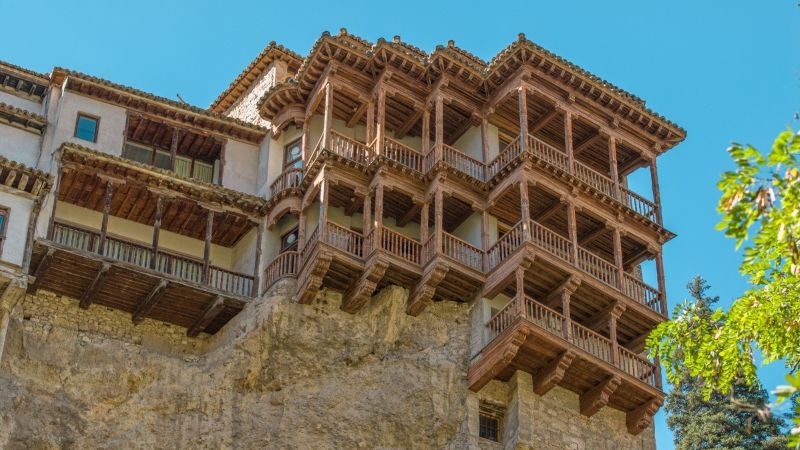
The Hanging Houses of Cuenca use cantilevered beams supported by internal walls to counterbalance the weight of their projecting balconies. Credit: Eve Livesey/Getty Images
How to build a house that clings to a cliff
Some structures begin where the ground ends. Houses that don’t rest on the earth, temples that seem suspended in mid-air, and buildings that cling to the rock as if they were part of it. In these places, architecture stops expanding and learns to support itself over empty space.
Clinging to a granite wall requires understanding the language of the rock. Since the Middle Ages, architecture has sought solutions that would allow people to inhabit the most extreme terrains, defying gravity as if floating above the void. The Hanging Houses of Cuenca, built in the 15th century, the monasteries of Meteora in Greece, suspended on near-vertical rock pillars, or contemporary designs such as Australia’s Cliff House, are structures that share the same idea: to build right on the boundary between solid ground and empty space.
Cuenca: Conquering Airspace
During the 15th century, the town of Cuenca established itself within the Kingdom of Castile as a strategic stronghold and the region’s economic hub. This growth created the need to accommodate an expanding population beyond the medieval walled fortress overlooking the gorges of the Júcar and Huécar rivers. The scarcity of available land led to the design of the Hanging Houses, a conquest of the void yet independent of it.
The construction relied on complex structural systems using cantilevered beams (known as almojayas) supported by the interior walls. These systems counterbalanced the weight of the overhanging balconies with the floor structure of the building’s lower level. The complex, which can be admired from across the river, was recognised as part of the historic walled town of Cuenca, which was declared a UNESCO World Heritage Site in 1996.
Meteora: Balance as Reinforcement
The Orthodox monasteries of Meteora (Greece) faced a different challenge: maintaining balance atop porous rock pinnacles, rising almost vertically above the plains near Kalambaka in Thessalian. As in Cuenca, the solutions employed reflected an adaptation to the environment.
The Orthodox-Byzantine monasteries of Meteora are built so that their weight distribution prevents the sandstone pinnacles on which they are perched from collapsing. Credit: Walter Weinberg / 500px/Getty Images
These towering pillars of sandstone and conglomerate, some of which reach up to 600 metres, were chosen by the Orthodox-Byzantine monks in the 14th century as sites for monasteries, offering refuge from Ottoman attacks. The unique setting, which translates from the Greek Μετέωρα as “suspended in the air”, was ideal for solitary spiritual practice and could only be accessed by long ladders or rope nets hoisted by pulleys.
In this feat of medieval engineering, the monks exploited natural cracks in the rock to wedge in wooden pegs and erect temporary scaffolding. The rock itself was used to build the walls and carve cisterns for collecting rainwater.
The weight distribution of the monasteries is typically concentrated at the centre of the pinnacle, which prevents the stone column from collapsing. The structure itself acts as a compression plug, sealing fissures in the porous sandstone and preventing them from expanding due to water infiltration.
The Evolution of the Cantilever: From Wood to Steel
These rock-based construction techniques have evolved into other extreme projects that seek minimal impact on the landscape. One such example is the houses in the Wangxian Valley in China, an example of rural regeneration where architecture revives the traditional aesthetics of the Xian ethnic group through cutting-edge engineering.
The dwellings are suspended from granite walls using cantilever principles, but rather than wooden beams, they employ concealed steel structures and high-strength bolts anchored into the rock. The same technical approach is employed in the as-yet-unbuilt Modscape Cliff House in Australia, a conceptual project designed to hang over a precipice on the Victorian coast.
The dwellings in China's Wangxian Valley are anchored to the rock using steel structures and high-strength bolts. Credit: Jaclyne Ortiz/Istockphoto
The proposed design consists of five modular units anchored to the rock with high-strength steel fixings, mimicking the way barnacles attach themselves to a ship’s hull. The stability of the structure is determined by the controlling of loads and the torsion of the structural elements, a technical challenge with a centuries-long history that can now be addressed through digital simulations and high-strength materials.
The desire to float above the landscape is not new. In the late 1960s, the modernist architect Harry Weese already defied gravity with the Shadowcliff, a glass and steel structure over Lake Michigan in Ellison Bay, Wisconsin. This demonstrated that steel could make it possible to inhabit the abyss without the need for massive foundations.
What once arose from defensive or spiritual needs in medieval times has evolved into extreme architectural solutions that test our ability to inhabit places where we were never meant to be.
Tungsteno es un laboratorio periodístico que explora la esencia de la innovación.
At Sacyr, we strive to implement industry best practices and enhance the experience of our clients and users, by elevating service quality and driving innovation. Our annual goal of achieving an average satisfaction score of 4/5 is aligned with our Quality, Environment, and Energy Policy, which is customer-centric and committed to continuous improvement. Analysis of the questionnaires confirms that 94% of clients are 'Satisfied' or 'Highly satisfied', with ratings of 4 or higher.
This website uses its own and third-party cookies to improve the user experience and analyze their behavior in order to improve the service offered.
You can consult additional information about the cookies installed on our Cookies policy.
These cookies are exempt from compliance with article 22.2 of the LSSI in accordance with the recommendations indicated by the European authority on privacy and cookies. In accordance with the above and although configuration, acceptance or denial is not possible, the editor of this website offers information about them in an exercise of transparency with the user.
Name: LFR_Session_STATE_*, Provider: Liferay, Purpose: Manages the session as a registered user , Expiration: Session, Type: HTTP
Name: GUEST_LANGUAGE_ID, Provider: Liferay, Purpose: Determines the language with which you access , to show the same in the next session, Expiration: 1 year, Type: HTTP
Name: ANONYMOUS_USER_ID, Provider: Liferay, Purpose: Manages the session as an unregistered user , Expiration: 1 year, Type: HTTP
Name: COOKIE_SUPPORT, Provider: Liferay, Purpose: Identifies that the use of cookies for the operation of the portal, Expiration: 1 year, Type: HTTP
Name: JSessionID, Provider: Liferay, Purpose: Manages login and indicates who is using the site, Expiry: Session, Type: HTTP
Name: SACYRGDPR, Supplier: Sacyr, Purpose: Used to manage the cookie policy , Expiration: Session, Type: HTTP
ANALYTICS
These cookies allow us to count visits and sources of circulation in order to measure and improve the performance of our site. They help us know which pages are the most or least popular, and see how many people visit the site. All the information collected by these cookies is aggregated and, therefore, anonymous.
Name: _ga_<container-id>, Provider: Google, Purpose: Collects data about the number of times a user has visited the website in addition to the dates of the first and most recent visit. Used by Google Analytics, Expiration: 2 years Type: HTTP
Name: _ga, Provider: Google, Purpose: Registers a unique ID that is used to generate statistical data about how the visitor uses the website, Expiration: 2 years Type: HTTP